Jasper Gemstone

The Gemstone “Jasper”

After a long sabbatical from my gemstone blog, I am back to my research into gemstones.

 “Jasper” is a very interesting gemstone that I’ve just been introduce to.  Jewelry made from this is extra beautiful.
Being such a touchy stone to work with, it is amazing what craftsmen have done with it.

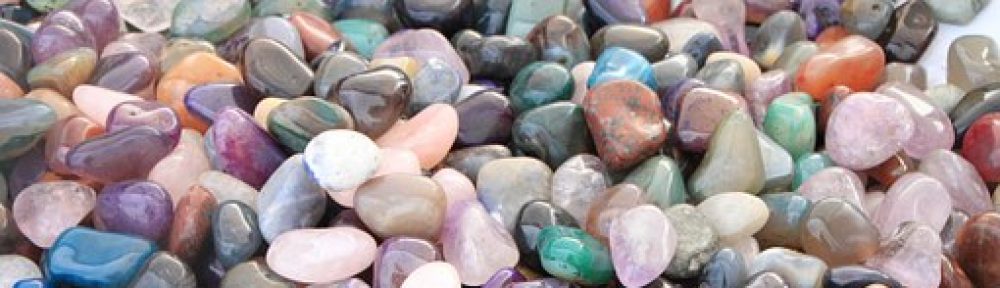
“Jasper” is a variety of quartz, but is put in it’s own category because of  the unique structure of veins and splotches.
The word jasper  is from the Greek language meaning “spotted stone”. In ancient times the word referred to green, transparent stones.

Modern jasper is very different today.  It is a dense stone with up to 20% inclusion (foreign material) that make up its color, streaks,blotches and grainy appearance.

This jasper is found in Egypt, Australia, Brazil, India, Canada, Russia, Uruguay, United States and still more countries…
It is not an easy stone to work with as it tends to crack along the layers of veins.
It is often called “blood jasper”  or “Bloodstone”  but I have just found out that “bloodstone” is a totally different gemstone,although the colors are much the same.

Jasper is found in a variety of colors. From yellow,brown or green blended to fine grained black and pink to light red and cloudy. There are at least 50 varieties, each having it’s own coloration.

Poppy Jasper

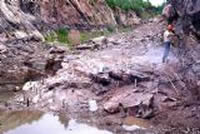
One of the most sought after types is “picture Jasper”. This gemstone actually comes out of the ground  with markings resembling trees or landscape scenes. At present “Biggs Jasper” is the most common source.  It is found in Oregon, USA.  You can visit Biggs Junction, Oregon and see picture junction being mined, with a little help you can pick some yourself.

Picture Jasper is petrified mud that has dripped into gas pockets of molten lava ( as the earth was formed) then solidifying  creating the unusual veined patterns.

In modern literature jasper is assigned to the planet Mars, in the Zodiac it belongs to Aries and it is also the state rock of Massachusetts USA.

In ancient times the stone was thought to bring rain.  It also was the protector against spiders and snakes. Even now there are as many positive powers given to the gemstone as there are varieties.


**Research:  Online: wikipedia  Offline: “Colored Gemstones” by Antoinette Matlins and “Gemstones of the World” by Walter Shuman as well as information picked up at a marvelous little store here in Guelph. called “Harmony”
OREGON OPAL

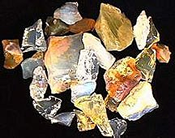
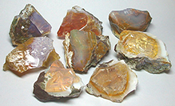
A unique variety of Opal found in only one place in the entire world – Opal,Butte, Oregon. When faceted it flashes dusky blue-violet or yellow-orange.  In some pendants, it is transparent, resembling an underwater scene.

Oregon Opal inspires imagination, rediscovery of self, joy and peace!! This is high quality gem grade material. One of my personal favorites!

Opal has been known for many years to be an emotional body stone, thought of as flowing water, because it is amorphous (with out crystal structure).

Resource “The Fossil Cartel Inc”  http://www.fossilcartel.com

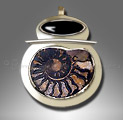
Fossil Jewelry – Ammonite

Ammonites are the ancient equivalent to the modern-day chambered Nautilus. These sea faring squids built a chambered shell in which they would pump air into the empty chambers and float at different levels of the ocean in search of food. This unique ability to float at different depths of the ocean is what inspired Jules Vern (the famous science fiction writer) to call the first submarine the Nautilus. Ammonites lived approximately 400 million years ago.

Source:  http://www.brenardine.com/fossil-jewelry.htm

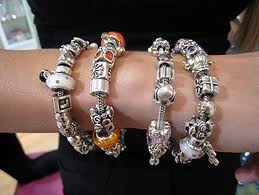
Pandora Bracelets

Imagine the conversations among your friends when you create your
own beautiful Pandora Bracelets with precious or semi-precious
gemstones.


Pandora is perhaps known best for its bourgeois twist on the
classic charm bracelet, introduced in 2000.

Pandora bracelets have a patented threading system that allows
charms to be placed, added and rearranged. Pandora has created
more than 800 handcrafted charms, available in sterling silver,
14k gold and murano glass, sometimes with semi-precious stones or
precious gems. Other accessories for the bracelets include spacers
and clips, which secure the loose beads in place and prevent them
from falling off the bracelet when it is opened. It also helps
with the distribution of weight allowing for minimal stretching.
One must screw each bead onto a small section at the beginning of
the bracelet and across two small fixed threads along the
bracelet. This allows for the separation of beads, creation of
patterns and prevents the beads from falling off. A safety chain
can also be used to prevent charms falling off and allow for extra
security and makes it easier to apply the bracelt onto a person’s
wrist.

In 2008, Pandora introduced “LovePods,” jewelry made of 18k gold
and gemstones such as diamonds, amethyst, peridot, citrine, spinel
and topaz. (Wikipedia)

Why not use precious stones and create your own Love Pods.

Sapphires & Rubies

Sapphires: Stone of Magic – Stone of Mystery

Ruby:  Deep Red and Rare – more expensive than diamonds!


Sapphires and Rubies are the mineral corundum.  It comes in a variety of colors and is the hardest mineral next to diamonds.
Only the deep red corundum is called Ruby. All other colors are sapphires. They are: blue, pink, green, violet, yellow and colorless.  There are even some orange ones.

The most sought after  is the bright, cornflower blue, that comes from Sri Lanka.

Saphires from Montana

Saphires from Montana

Ancient Europeans considered the blue sapphire protection against evil and general misfortunes.  They were carried into battle as victory stones.

The Ruby had the same reputation.

Raw Rubies

Raw Rubies

However in India, sapphires were considered to either bring great wealth and success or great misfortunes.  This tended to off-set their popularity in that country.

The finest Rubies come from Burma. Lesser stones come from Thailand, Cambodia, Africa as well as Brazil and China.

Sapphires come from Australia, Cambodia, and even from the US state of Montana.  Some have been found in Northern Ontario, Canada.   But only in Sri Lanka and Cambodia will you find the cornflower blue.

IN 1947, the first synthetic sapphires were created. They are equal to the natural stones in the chemical make up. They are flawless. That is one of the only ways they can be detected.

Natural stones always have some defect. The synthetics are  less expensive and easily  come by.

Natural stones are prized for their beauty and the fact that they have never been touched by human influence. Being rare they are highly expensive, especially the ruby.

It is said that a person born in Taurus should wear SAPPHIRE BLUE to be protected from mental disorders and a Capricorn who wears RUBY will never know trouble. (Wish I had known that fact sooner, I am a Capricorn and could have really used that protection.)

I wonder if anyone has done a study on these superstitions…….

Resources:

Wikipedia

The Encyclopedia of Minerals and Gemstones,

Jewelry & Gems, The Buying Guide,  by Antoinette Matlins,

As well as:  http://www.gehnabazaar.com.

If you are looking for loose stones or unique jewelry pieces, go to :

http://tinyurl.com/rc5lfc

For designer jewels visit:

http://tinyurl.com/lnso7r

Famous Diamonds

The Notorious Hope Diamond

The Notorious Hope Diamond

There are many famous diamonds. Some have been around for hundreds of years. That is what is so amazing about these gemstones. They have histories that have been traced down through the ages.

One of the most famous diamonds of all is the “Blue Hope” now on display in the Smithsonian Institute in the US state of Washington.

The “Blue Hope” has a notorious history.   It is supposed to carry a curse that anyone who owns or even touches the blue stone will live out their days in misery, poverty and sometimes unexpected death such as suicide.  This has happened to many of it’s owners, of course that could have happened naturally from poor business practices and bad habits.

The original stone, before it was cut weighed 3106 carats, the largest diamond ever found.  Rumor says that it was stolen from the eye of a Hindu  idol, and that the temple priests created the curse.  Modern experts believe the curse was invented by a diamond merchant to make the stone more interesting.

The original French merchant who acquired the stone either by theft or by legal means, did die in poverty.

The large diamond comes from the Kollur mine in Golconda, India. At that time it was crudely cut in a triangular shape, the cut diamond weighing just over 112 carats. The year was 1668, when That merchant sold what he called a” beautiful violet stone” (un beau violet) to King Louis XIV of France.

The King had the stone recut to a 67ct diamond and had it suspended on a neck ribbon which he wore on special occasions.

In 1749, King Louis XV, had the stone, then known as the “French Blue” reset into a piece of Royal Jewelry called the “Golden Fleece”. Then in 1791, in the French Revolution,King Louis XVI and Marie Antoinette attempted to flee France with the Royal jewels but were caught.The jewels were handed over to the government and the fleeing monarch and his paramour were beheaded. In the upheaval of the revolution the “French Blue” was stolen.

History next notes a large blue diamond in the possession of a London diamond merchant in 1812;  it is believed to be the “French Blue”. The stone is then sold to King George IV of England. Upon his death in 1830 the diamond is sold to help cover his enormous debts.

Next we find the blue stone in the gem catalog of  diamond merchant Henry Phillip Hope. It is now called the “Hope” diamond. The diamond passes down through the Hope family, from Henry Philip to Henry Thomas Hope, to a Grandson, Lord Francis Hope. All died in bankruptcy. Again the stone was sold to pay off debts.

This time it crossed the Atlantic to Joseph Frankels of New York city, who also ended in debt.

In 1911 the blue diamond was owned by Pierre Cartier, who had the stone reset  as the middle stone of a headpiece of large white diamonds. This piece was sold to a Mrs. Walsh McLean of Washington  DC.

She eventually had the stone reset into a pendant, which is how we see it today.  It is said that she wore it always and would not take it off.  Mrs. McLean owned the “blue hope” until she died in 1947.   She also had many instances of bad luck but never attributed it to the diamond.

Harry Winston purchased her jewelry, “Blue Hope” included, at the estate sale in 1949.  Winston displayed the blue diamond in many exhibits, then in 1958 Winston Inc, of New York city donated the large blue diamond to the Smithsonian  Institute where it immediately became their star attraction……  It has since traveled four times,  in 1962 to France, to be displayed in the “Ten Centuries of French Jewels”, in 1965, to South Africa for the ‘Rand Easter Show” 1984 saw the Blue Hope at Harry Winston’s 50th anniversary exhibit and then in 1996 back to New York, to Harry Winston, for cleaning and minor restoration.

The modern weight of this famous  blue diamond is 45.5 carats.  The blue shade is the result of trace amounts of boron in the stone.

The pendant surrounding the “Hope” is made up of 16 white diamonds and the neck chain contains 45 smaller white diamonds.

Modern gemologists using a color-meter  found the stone to have a slight tinge of violet mixed in with the blue which takes us back to the original “un beau violet”  1668.

This famous diamond has had a fascinating life!

Resources: Wikipedia, About.com, the Smithsonian Institute

A Karat, A Carrot, A Carat ? How Do We Measure a Diamond?

Karat is the Gold measurement. It is used to measure the purity of gold.

Carrots, of course, are bunny food and diet snacks.

Diamonds are weighed by the carat (ct)  One carrot weighs 200 milligrams or 1/2 gram.  This has been the weigh scale since 1913. Before that, the carat differed from country to country.  An older stone could weigh heavier than the modern weight.

Carat weight is often referred to as points. One carat = 100 pts.

A stone with 25 points = 1/4 carat.

This is weight not size.

Diamonds are priced by the carat and quality of the stone.  A very fine diamond weighing  1 carat would be much higher priced than one of poorer quality.

Another term used by jewelers is  “spread”  This refers to the  “look”  of the diamond.  A lot is determined by the cut of the jewel.

The way it is cut and set into a casing can make the stone appear much larger than it really is.

The carat weight is always determined before it is put in a setting. However some jewelers may price by the “look” of the stone.

To avoid this always by from reputable dealers.

When buying a very valuable diamond, you should always receive a certificate of worth.  You should also have it appraised by a certified gemologist.  Beware of scammers – even on New York’s famous 47th street.  Research and be knowledgeable.  take the time to get it right – after all a diamond last a lifetime.

For examples of settings and spread click here.

An excellent book for anyone thinking of purchasing precious stones is

“Jewelry and Gems” The Buying Guide – by Antoinette Matlins

Our resources: “Jewelry and Gems”  as well as Wikipedia, also” The Encyclopedia  of Gemstones and Minerals ” by Martin Holden.

Diamonds -“Adamas” – The Invincible

The hardest substance on earth!  A stone that men have killed for and women swoon over.  The subject of many movies as well as police reports.

In ancient times soldiers wearing diamonds in their shields were considered invincible.

The diamond is made out of four known polymers of carbon, accounting for its’ extreme hardness.  It takes  mighty strength to break a diamond and  they can only be scratched by another diamond.

The first diamonds came from India, they were uncut crystals. At that time their value was less than pearls or colored stones.  Then in the middle ages they became more popular being used mostly as talismans, granting the wearer supernatural powers and invincibility in battle. The wearer was thought to be more courageous as well as being protected from all sorts of illnesses.

Diamonds were credited with many magical powers, such as driving away the devil and other evil spirits, enhancing the love of a spouse and could even predict guilt or innocence when worn by a high priest in the Talmud.  The stone was said to glow brightly if the accused was innocent but grow very dim if guilty.

Diamonds come from very deep in the  earth, where temperatures reach 1000 degrees Celsius or more . The pressure is more than 50,000 times that of the Earth’s surface.  They are brought to the surface by eruptions of gases that explode into underground fissures called diamond pipes. The rocks that result from these explosions are called kimberlite and contain pieces of igneous rocks  in which the diamond crystals are found.

Most of these crystals are colorless, colored crystals do exist but are extremely rare.  Blue diamonds are found when crystals come in contact with the mineral boron.  Other minerals cause different tints.

Natural diamond crystals  can be transparent, translucent or opaque. Their luster is caused from being highly  refractive.  The variety of transparency is due to the strong dispersion of light.   These colors display best in a brilliant cut gemstone. ( the most common diamond cut)

India remained the main  diamond producer until the 1700’s, when a diamond discovery in Brazil took away some of the business.

Then in 1866, in South Africa, a little boy was discovered playing with a 21 caret stone.  This lead to the creation of the largest diamond mines  in the world.  Here, also  is where the” Cullinan” diamond, weighing in at 3106 carats, was found.  The biggest diamond ever.

There are other diamond deposits all around the world – the Ural mountains of Russia – Siberia – western Australia – Appalachian mountains in California – Pike County in Arkansas – the glacial morain around the great lakes area of Canada  and of course the search continues.

raw-diamond

Raw Diamond

Welcome to the Gemstone Blog

Featured

This is a place to learn all about precious gemstones.  Where they are found and how they are made.

Which are the most sought after and the most rare.

We will look into the history of many of the gems and discuss their origins, colors, folklore and why they are prized by Kings and commoners alike.

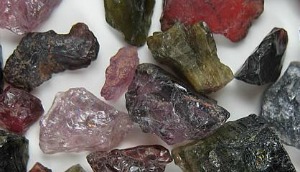
many colors of garnets

many colors of garnets

Gemstones come from all over the world.  Some have even been found in Meteorites. (special kind of peridot)  Very Rare!  Some can be hand picked in National Parks, in the USA, or in private mines that have opened to the public such as the one below in Ontario, Canada

Amethyst Mine Panarama, Thunder Bay,  Ontario, Canada

Amethyst Mine Panarama, Thunder Bay, Ontario, Canada

Remember, A gemstone, by it’s nature, is a  “Forever” gift.

Have a great Day,

Erma