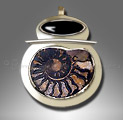
Fossil Jewelry – Ammonite

Ammonites are the ancient equivalent to the modern-day chambered Nautilus. These sea faring squids built a chambered shell in which they would pump air into the empty chambers and float at different levels of the ocean in search of food. This unique ability to float at different depths of the ocean is what inspired Jules Vern (the famous science fiction writer) to call the first submarine the Nautilus. Ammonites lived approximately 400 million years ago.

Source:  http://www.brenardine.com/fossil-jewelry.htm

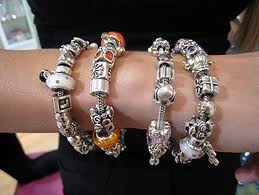
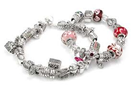
Pandora Bracelets

Imagine the conversations among your friends when you create your
own beautiful Pandora Bracelets with precious or semi-precious
gemstones.


Pandora is perhaps known best for its bourgeois twist on the
classic charm bracelet, introduced in 2000.

Pandora bracelets have a patented threading system that allows
charms to be placed, added and rearranged. Pandora has created
more than 800 handcrafted charms, available in sterling silver,
14k gold and murano glass, sometimes with semi-precious stones or
precious gems. Other accessories for the bracelets include spacers
and clips, which secure the loose beads in place and prevent them
from falling off the bracelet when it is opened. It also helps
with the distribution of weight allowing for minimal stretching.
One must screw each bead onto a small section at the beginning of
the bracelet and across two small fixed threads along the
bracelet. This allows for the separation of beads, creation of
patterns and prevents the beads from falling off. A safety chain
can also be used to prevent charms falling off and allow for extra
security and makes it easier to apply the bracelt onto a person’s
wrist.

In 2008, Pandora introduced “LovePods,” jewelry made of 18k gold
and gemstones such as diamonds, amethyst, peridot, citrine, spinel
and topaz. (Wikipedia)

Why not use precious stones and create your own Love Pods.

Sapphires & Rubies

Sapphires: Stone of Magic – Stone of Mystery

Ruby:  Deep Red and Rare – more expensive than diamonds!


Sapphires and Rubies are the mineral corundum.  It comes in a variety of colors and is the hardest mineral next to diamonds.
Only the deep red corundum is called Ruby. All other colors are sapphires. They are: blue, pink, green, violet, yellow and colorless.  There are even some orange ones.

The most sought after  is the bright, cornflower blue, that comes from Sri Lanka.

Saphires from Montana

Saphires from Montana

Ancient Europeans considered the blue sapphire protection against evil and general misfortunes.  They were carried into battle as victory stones.

The Ruby had the same reputation.

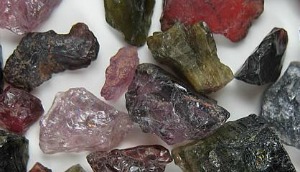
Raw Rubies

Raw Rubies

However in India, sapphires were considered to either bring great wealth and success or great misfortunes.  This tended to off-set their popularity in that country.

The finest Rubies come from Burma. Lesser stones come from Thailand, Cambodia, Africa as well as Brazil and China.

Sapphires come from Australia, Cambodia, and even from the US state of Montana.  Some have been found in Northern Ontario, Canada.   But only in Sri Lanka and Cambodia will you find the cornflower blue.

IN 1947, the first synthetic sapphires were created. They are equal to the natural stones in the chemical make up. They are flawless. That is one of the only ways they can be detected.

Natural stones always have some defect. The synthetics are  less expensive and easily  come by.

Natural stones are prized for their beauty and the fact that they have never been touched by human influence. Being rare they are highly expensive, especially the ruby.

It is said that a person born in Taurus should wear SAPPHIRE BLUE to be protected from mental disorders and a Capricorn who wears RUBY will never know trouble. (Wish I had known that fact sooner, I am a Capricorn and could have really used that protection.)

I wonder if anyone has done a study on these superstitions…….

Resources:

Wikipedia

The Encyclopedia of Minerals and Gemstones,

Jewelry & Gems, The Buying Guide,  by Antoinette Matlins,

As well as:  http://www.gehnabazaar.com.

If you are looking for loose stones or unique jewelry pieces, go to :

http://tinyurl.com/rc5lfc

For designer jewels visit:

http://tinyurl.com/lnso7r
A Karat, A Carrot, A Carat ? How Do We Measure a Diamond?

Karat is the Gold measurement. It is used to measure the purity of gold.

Carrots, of course, are bunny food and diet snacks.

Diamonds are weighed by the carat (ct)  One carrot weighs 200 milligrams or 1/2 gram.  This has been the weigh scale since 1913. Before that, the carat differed from country to country.  An older stone could weigh heavier than the modern weight.

Carat weight is often referred to as points. One carat = 100 pts.

A stone with 25 points = 1/4 carat.

This is weight not size.

Diamonds are priced by the carat and quality of the stone.  A very fine diamond weighing  1 carat would be much higher priced than one of poorer quality.

Another term used by jewelers is  “spread”  This refers to the  “look”  of the diamond.  A lot is determined by the cut of the jewel.

The way it is cut and set into a casing can make the stone appear much larger than it really is.

The carat weight is always determined before it is put in a setting. However some jewelers may price by the “look” of the stone.

To avoid this always by from reputable dealers.

When buying a very valuable diamond, you should always receive a certificate of worth.  You should also have it appraised by a certified gemologist.  Beware of scammers – even on New York’s famous 47th street.  Research and be knowledgeable.  take the time to get it right – after all a diamond last a lifetime.

For examples of settings and spread click here.

An excellent book for anyone thinking of purchasing precious stones is

“Jewelry and Gems” The Buying Guide – by Antoinette Matlins

Our resources: “Jewelry and Gems”  as well as Wikipedia, also” The Encyclopedia  of Gemstones and Minerals ” by Martin Holden.

Welcome to the Gemstone Blog

Featured

This is a place to learn all about precious gemstones.  Where they are found and how they are made.

Which are the most sought after and the most rare.

We will look into the history of many of the gems and discuss their origins, colors, folklore and why they are prized by Kings and commoners alike.

many colors of garnets

many colors of garnets

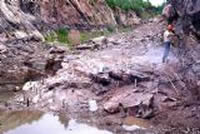
Gemstones come from all over the world.  Some have even been found in Meteorites. (special kind of peridot)  Very Rare!  Some can be hand picked in National Parks, in the USA, or in private mines that have opened to the public such as the one below in Ontario, Canada

Amethyst Mine Panarama, Thunder Bay,  Ontario, Canada

Amethyst Mine Panarama, Thunder Bay, Ontario, Canada

Remember, A gemstone, by it’s nature, is a  “Forever” gift.

Have a great Day,

Erma